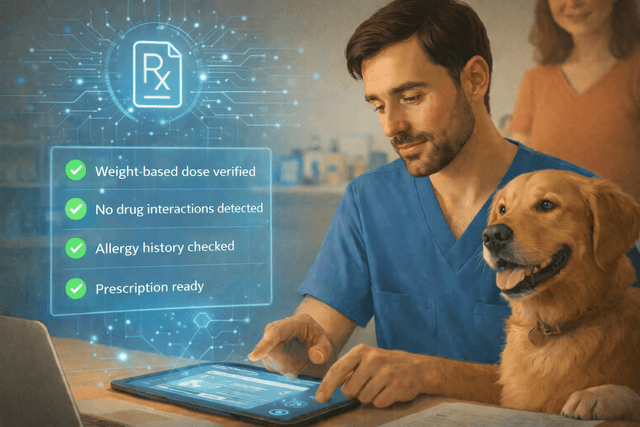
Veterinary medicine is entering a new phase of technological development. Artificial intelligence is already beginning to appear across many areas of clinical workflow, and AI in veterinary prescribing is quickly becoming one of the most important developments.
These early applications are not replacing veterinarians. They are improving the systems that support them.
Prescribing is one of the next areas where artificial intelligence will have a meaningful impact, particularly as AI in veterinary prescribing begins supporting safety checks and workflow management.
Today, the prescribing process involves far more than simply selecting a medication. Veterinary teams spend a significant amount of time managing prescription requests, reviewing refills, coordinating with outside pharmacies, and making sure prescriptions move through the system correctly.
As veterinary medicine continues to modernize its prescribing infrastructure, artificial intelligence will increasingly play a role in supporting these workflows.
The opportunity is not replacing the veterinarian’s decision. It is improving the systems surrounding that decision so prescribing becomes safer, faster, and more intelligent.
How AI Will Actually Be Used in Veterinary Prescribing
Artificial intelligence will not replace the veterinarian’s role in prescribing. The veterinarian remains responsible for the clinical decision, while AI helps support the process with safety checks, verification, and workflow assistance.
One of the most immediate applications is drug interaction detection. AI systems can automatically cross-reference a prescription against known drug interactions, contraindications, and species-specific safety considerations. If a medication conflicts with another drug the patient is currently taking, the system can alert the veterinarian before the prescription is finalized. These checks add an additional layer of safety without slowing down the clinical workflow.
AI can also assist with weight-based dose calculations. Many veterinary medications require dosing based directly on patient weight. AI systems can automatically confirm that the prescribed dosage aligns with the patient’s recorded weight and recommended dosing guidelines. If something does not match—such as an outdated weight entry or an incorrect calculation—the system can prompt the veterinarian to review the prescription before it moves forward.
Another important capability is allergy and medical history checks. AI systems can review the patient’s record and identify previous adverse reactions, allergies, or medication sensitivities that may conflict with a new prescription. If a patient has previously experienced a reaction to a medication or class of drugs, the system can surface that information immediately during the prescribing process.
Artificial intelligence can also help identify patterns through refill monitoring. By analyzing refill activity over time, AI systems can detect situations where refill requests occur much earlier than expected or where refill patterns fall outside typical treatment schedules. These insights help veterinary teams identify potential administrative errors or unusual prescription activity that may require additional review.
Individually, these capabilities improve specific parts of the prescribing workflow. Together, they begin to create a more intelligent prescribing ecosystem—one where safety checks and verification processes operate continuously in the background.
Why Infrastructure Will Determine the Impact of AI
While the potential of artificial intelligence in veterinary prescribing is significant, its effectiveness depends on something more fundamental.
Infrastructure.
Artificial intelligence relies on structured data and connected systems to operate effectively. Workflows that depend on fax, manual data entry, and disconnected portals limit what AI can realistically accomplish.
For intelligent prescribing to emerge, prescription data must move through secure digital networks that connect veterinary practices, practice management systems, pharmacies, and pharmacy software platforms.
When these systems communicate through shared frameworks—similar to the standards used in human healthcare—AI systems can begin analyzing prescribing workflows at scale.
Without that connectivity, AI remains limited to isolated tools.
With it, the prescribing process becomes safer, faster, and more efficient across the entire ecosystem.
The Future of Veterinary Prescribing
Artificial intelligence will not replace veterinarians, nor will it make clinical decisions independently.
What it will do is strengthen the infrastructure surrounding veterinary care.
AI will verify prescription data, detect potential medication conflicts, monitor refill activity, and help ensure prescriptions move through the system accurately. By automating these verification processes, artificial intelligence reduces administrative burden while improving safety and visibility.
The transition from digital prescribing to intelligent prescribing will not happen overnight.
But as veterinary medicine continues to modernize its prescribing infrastructure, artificial intelligence will increasingly function as a support layer that strengthens the entire system.
The veterinarian remains at the center of the prescribing decision.
AI simply helps the surrounding ecosystem operate more intelligently.
FAQ
How will AI be used in veterinary prescribing?
AI will assist with tasks such as drug interaction detection, weight-based dosage calculations, allergy and medical history checks, and refill monitoring.
Will AI replace veterinarians when prescribing medication?
No. Artificial intelligence is designed to support veterinarians by improving workflow efficiency and safety checks. Clinical decisions remain the responsibility of the veterinarian.
Can AI detect medication errors in veterinary prescriptions?
Yes. AI systems can identify potential drug interactions, verify weight-based dosing, and flag conflicts with a patient’s medical history.
Why does AI require modern prescribing infrastructure?
AI relies on structured data and connected systems. Digital prescribing networks allow AI tools to analyze workflows and provide safety checks that improve efficiency and accuracy.